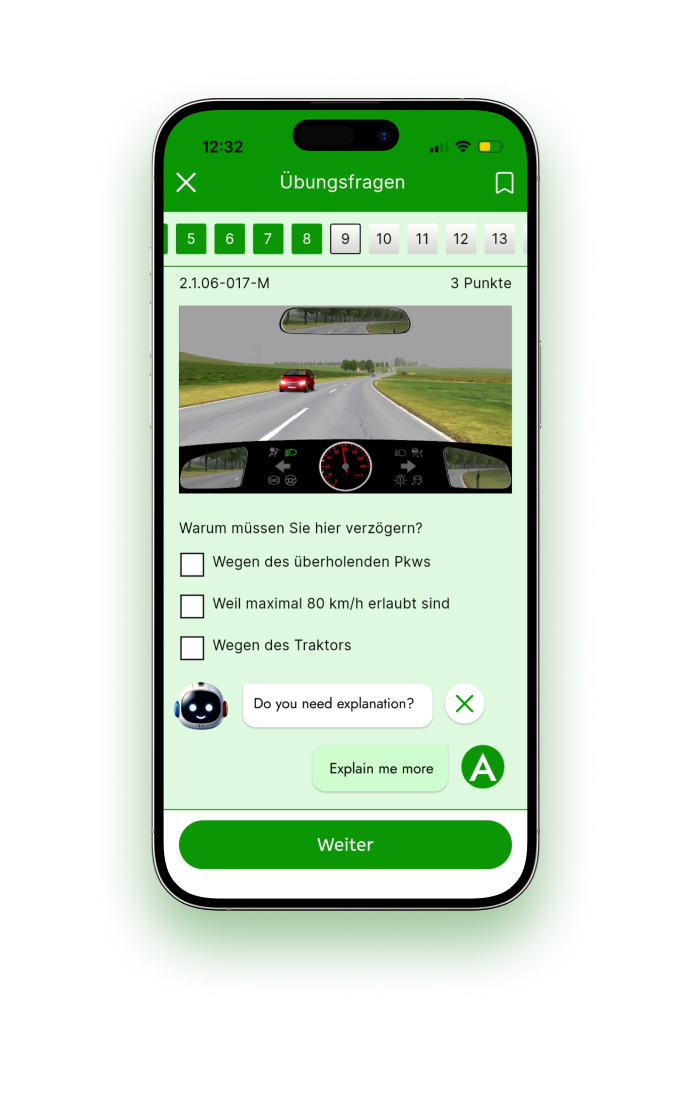
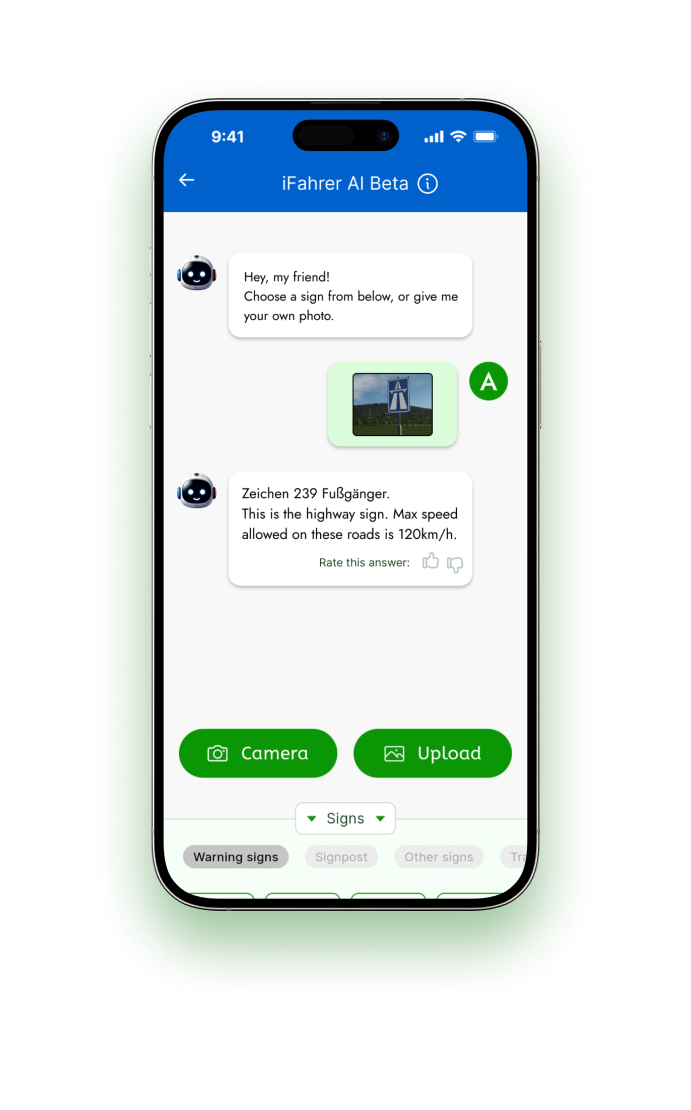
Get ready for your license test with AI assistance!
You are travelling at 100 km/h, have a reaction time of 1 second, and brake normally. What is the stopping distance according to the rule of thumb?
Answer: 130 m
Here is Our AI Assistant's Explanation
With the German “rule of thumb” (Faustformel), the stopping distance is the sum of reaction distance and braking distance.
At 100 km/h, you cover about 28 meters per second in real life, but the rule of thumb uses an easy approximation: reaction distance = speed/10 × 3. With 100 km/h and 1 second reaction time, that is 100/10 × 3 = 10 × 3 = 30 m.
For “normal braking,” the rule of thumb is braking distance = (speed/10)². So at 100 km/h: (100/10)² = 10² = 100 m.
Stopping distance = 30 m + 100 m = 130 m, which is why your answer is correct.
Rule to remember for similar questions: reaction distance grows linearly with speed, but braking distance grows with the square of speed, so at higher speeds the braking part dominates quickly.